
Let’s face it, ‘analysis’ can be a terribly off-putting word. Partly because we have a hard time grasping what it even means. At its core, analysis is about breaking down complex things into manageable parts to examine them. The Analytic Spectrum does a fantastic job at visualising various types of analysis. It’s taken from the book Critical Thinking for Strategic Intelligence by Kathy and Randy Pherson, two former intelligence analysts.
Even better, the spectrum makes analysis feel less intimidating. By showing that there are different ways to approach a problem, each requiring a different set of tools depending on the question at hand.
What Is the Analytic Spectrum?
The Analytic Spectrum is a practical framework that breaks down our thought processes into four types: descriptive, explanatory, evaluative, and estimative. This breaks the dreaded word of ‘analysis’ down further and helps you choose the right approach for each question.
- Descriptive Analysis: Who? What? Where? How? e.g. Breaking down newsletter stats, describing how many people visited when and from where.
- Explanatory Analysis: Why? e.g. Identifying the use of the word analysis in your headline as the cause for low traffic.
- Evaluative Analysis: So what? What does it mean? Examining what measures could lead to an improvement in traffic, such as using clickbait headlines.
- Estimate Analysis: What happens next? Forecasting the development of website traffic if you switched to clickbait headlines altogether.
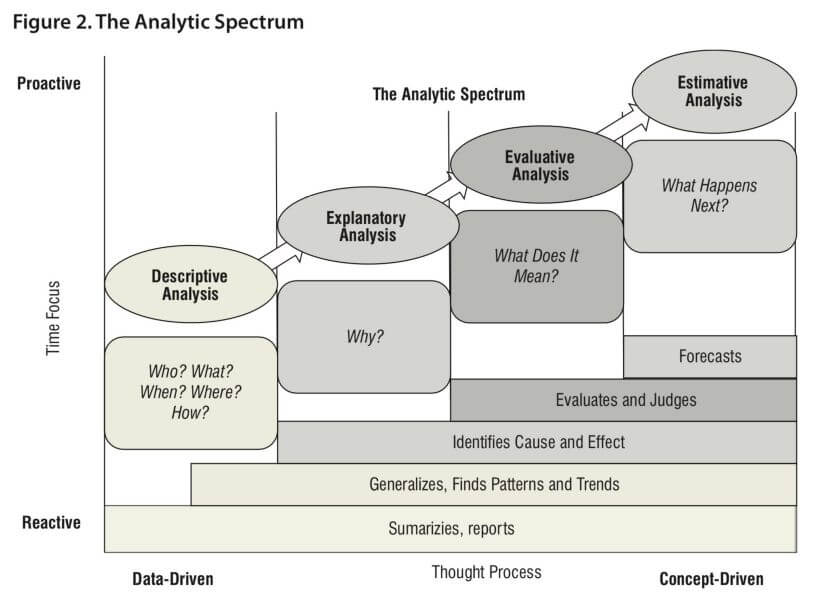
All four differ in their time focus in that descriptive analysis is rather reactive, while estimate analysis is proactive. While descriptive analysis heavily relies on data, estimate analysis is driven by concepts since the future data doesn’t exist yet.
Why the Analytic Spectrum Matters
One of the Phersons’ key points is that these categories aren’t just different styles of analysis, but different thinking tasks. Problems start when we mix them up — when we treat explanations like facts, or forecasts like evaluated conclusions.
Another useful insight is that none of these categories is “better” than the others. Descriptive analysis lays the groundwork. Explanatory analysis introduces causality, which is always probabilistic. Evaluative analysis adds judgment and trade-offs. Estimative analysis, finally, deals almost entirely with uncertainty and possible futures.
Importantly, uncertainty increases as you move along the spectrum. Descriptions can usually be checked against data. Estimates can’t be confirmed until later, if ever. That’s why good estimative analysis focuses less on being right and more on being clear about assumptions and confidence.
Kathy and Randy also stress that different parts of the spectrum need different tools. Data checks help descriptive work. Alternative hypotheses matter most for explanations. Clear criteria are essential for evaluation. And estimates benefit from scenarios and probability ranges.
Closing Thoughts
The Analytic Spectrum isn’t a rigid process. It’s a way to be clear about what kind of thinking you’re doing and what your conclusions can realistically support. And to make the dreaded word ‘analysis’ a little less scary.
If you’d like to take a deeper dive into analytical techniques, check out my articles on How to Do Satellite Image Analysis or Randy Pherson’s Structured Analytic Techniques.
